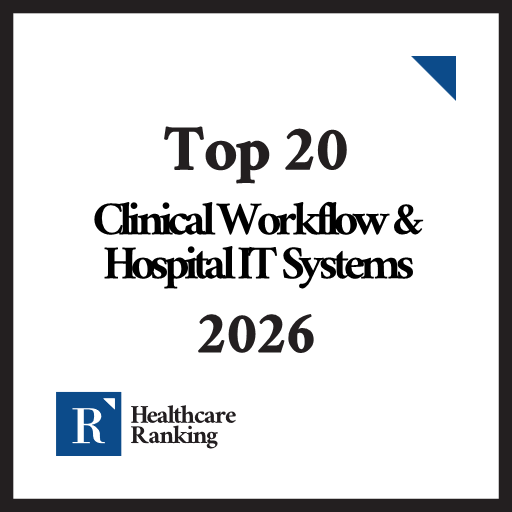
Top 20 Clinical Workflow & Hospital IT Systems 2026

Review categories
- Medical Device Manufacturers
- Surgical Robotics & Advanced Equipment Firms
- Digital Health Platforms
- Telemedicine Providers
- Remote Monitoring & Wearable Health Technology Providers
- Clinical Workflow & Hospital IT Systems
- Health Data Infrastructure & Interoperability Platforms
- Digital Therapeutics & Consumer Health Technology Providers
[email protected]
Authored On
Modified
This report forms part of the Ranking News Healthcare Ranking series, which evaluates hospitals, medical institutions, pharmaceutical organizations, medical technology companies, diagnostics providers, laboratories, precision medicine platforms, pharmaceutical services providers, medical technology firms, and healthcare systems across global healthcare markets.
Clinical workflow and hospital IT systems providers occupy one of the most mission-critical segments of healthcare technology. These companies develop the electronic health records, clinical documentation systems, computerized physician order entry platforms, patient portals, interoperability tools, hospital information systems, imaging informatics, clinical decision support, revenue cycle workflows, medication management tools, and operational systems that support modern healthcare delivery.
Unlike consumer digital health platforms or standalone telemedicine providers, hospital IT systems are embedded inside the daily operations of hospitals, health systems, physician groups, laboratories, imaging departments, emergency departments, operating rooms, pharmacies, nursing units, and administrative teams. Their relevance depends not only on software features, but also on uptime, implementation quality, clinical usability, interoperability, cybersecurity, regulatory compliance, enterprise integration, and long-term vendor stability.
The sector has become more strategically important as healthcare systems shift from paper records and fragmented departmental systems toward integrated clinical platforms. Electronic health records have become the operational core of hospitals, while AI documentation, ambient clinical intelligence, data exchange, clinical analytics, imaging workflows, and patient engagement are increasingly layered on top of core hospital IT infrastructure.
This ranking identifies clinical workflow and hospital IT systems providers whose platforms demonstrate sustained relevance across enterprise EHR, clinical operations, hospital information systems, interoperability, imaging workflow, physician productivity, patient access, and health-system infrastructure. Rather than focusing only on software revenue or brand awareness, the objective is to recognize specific license-targetable firms whose systems are structurally important to healthcare delivery.
Market Overview
The clinical workflow and hospital IT market remains highly concentrated at the enterprise EHR layer, especially in the United States. Epic continues to hold the strongest position in acute-care hospital EHR installations, with recent industry data placing Epic at approximately 43.9% of U.S. hospital installations and Epic plus Oracle Cerner together accounting for more than 62% of the U.S. inpatient EHR market.
Oracle Health, formerly Cerner, remains the second major enterprise hospital EHR platform, particularly relevant in large health systems, government deployments, and international markets. Oracle acquired Cerner for $28.3 billion in 2022, the largest acquisition in Oracle’s history, and has since been working to reposition the platform around cloud, data, and AI-enabled healthcare infrastructure.
MEDITECH remains a major hospital EHR vendor, especially among community hospitals, mid-sized health systems, and international providers. KLAS’ 2025 Best in KLAS coverage identified Epic as the top overall health system suite, followed by MEDITECH and Oracle Health, while athenahealth led the independent physician practice suite category.
Outside the United States, vendors such as Dedalus, InterSystems, Altera Digital Health, Philips, Sectra, Agfa HealthCare, and Siemens Healthineers play important roles in hospital information systems, clinical documentation, imaging informatics, interoperability, and regional health data infrastructure. Imaging workflow and enterprise radiology systems remain especially important because hospitals increasingly require integrated imaging, AI triage, reporting, archiving, and multidisciplinary collaboration across radiology, cardiology, oncology, emergency care, and surgery.
The market is also being reshaped by AI. Ambient documentation, automated summarization, clinical inbox management, prior authorization support, coding assistance, revenue cycle automation, and clinical decision support are becoming core workflow priorities. Epic’s expanding AI capabilities, Microsoft’s Nuance DAX platform, Oracle’s AI-native EHR ambitions, and growing third-party integration activity all reflect the movement from passive recordkeeping toward active workflow intelligence.
Industry Trend — 2026
The clinical workflow and hospital IT systems industry in 2026 is shaped by five major trends: EHR modernization, AI-enabled documentation, interoperability pressure, enterprise consolidation, and specialty workflow integration.
First, hospitals are accelerating EHR modernization. Becker’s Hospital Review reported in 2025 that hospitals and health systems were accelerating EHR modernization, with Epic, Oracle Health, and MEDITECH emerging as leading vendors in transitions aimed at improving interoperability, workflow efficiency, and digital transformation.
Second, AI-enabled clinical documentation has become a strategic battleground. Ambient scribing, note summarization, discharge documentation, coding assistance, and physician workflow automation are increasingly important as clinicians face burnout and documentation burden. Business Insider reported on the complex competitive relationship between Epic and Abridge as Epic developed competing AI tools with Microsoft’s Nuance, illustrating how EHR vendors and AI documentation companies are converging around the same workflow layer.
Third, interoperability remains a major priority. Hospitals need patient records, imaging, laboratory results, medications, referrals, and claims data to move across institutions and care settings. Vendors with mature interoperability frameworks, health information exchange capabilities, FHIR support, and patient portal infrastructure are better positioned as regulators, patients, and providers demand more accessible health data.
Fourth, enterprise consolidation continues. Health systems increasingly prefer fewer platforms that can support clinical documentation, revenue cycle, patient engagement, analytics, and specialty workflows. This creates advantages for broad vendors such as Epic, Oracle Health, MEDITECH, Dedalus, InterSystems, Philips, GE HealthCare, and Siemens Healthineers, while also pressuring smaller departmental software vendors.
Fifth, specialty workflows are becoming more integrated into enterprise platforms. Radiology, cardiology, oncology, emergency medicine, operating rooms, pharmacy, ICU, pathology, and revenue cycle functions increasingly require tight integration with the core EHR. Imaging informatics firms such as Sectra, Agfa HealthCare, Philips, Siemens Healthineers, and GE HealthCare remain relevant because hospitals still depend on specialized workflow systems that cannot be fully replaced by general-purpose EHRs.
Methodology — Core Eligibility Criteria
To ensure structural consistency within the category, organizations considered for this ranking were evaluated based on the following eligibility conditions:
- Operates as a clinical workflow system provider, hospital IT platform, electronic health record vendor, hospital information system provider, imaging informatics company, interoperability platform, clinical documentation provider, or healthcare enterprise software firm
- Provides products such as EHR, EMR, hospital information systems, clinical documentation, CPOE, patient portals, interoperability tools, clinical decision support, imaging workflow systems, revenue cycle workflows, medication management, care coordination, or hospital analytics
- Maintains meaningful institutional scale through hospital deployments, health-system contracts, physician adoption, government or enterprise implementations, international reach, or embedded clinical workflow usage
- Demonstrates relevance in hospital operations, physician workflow, patient records, care coordination, clinical documentation, imaging workflow, health information exchange, or enterprise healthcare IT
- Represents a specific license-targetable operating organization, rather than a broad ecosystem category, trade association, informal network, academic project, or generic platform label
Pure consumer wellness apps, scheduling-only tools without broader clinical workflow relevance, early-stage software startups without sufficient deployment scale, consulting-only firms, and non-healthcare enterprise software providers without meaningful clinical workflow products were generally excluded.
Methodology — Ranking Factors
Organizations included in the ranking were evaluated using a combination of qualitative and structural considerations rather than short-term revenue alone. Key factors considered include:
- Scale and maturity of hospital IT or clinical workflow platform
- Depth of EHR, hospital information system, imaging workflow, or clinical documentation capability
- Health-system, hospital, physician, or enterprise adoption
- Interoperability, patient portal, data exchange, and integration strength
- Clinical usability, workflow efficiency, reliability, and implementation track record
- AI readiness, ambient documentation, clinical decision support, and automation capability
- Cybersecurity, regulatory compliance, uptime, and data governance
- Institutional stability, brand reputation, and long-term platform resilience
The objective of the ranking is to identify clinical workflow and hospital IT systems providers whose platforms maintain sustained relevance within the global healthcare ecosystem.
The Healthcare Ranking Top 20 Clinical Workflow & Hospital IT Systems 2026 ranking evaluates companies based on enterprise healthcare IT scale, clinical workflow relevance, hospital adoption, interoperability, AI readiness, specialty workflow depth, and long-term institutional resilience.
The ranking universe consisted of approximately 150 clinical workflow and hospital IT systems providers globally, from which 20 organizations were selected for inclusion.
Tier classifications reflect relative institutional positioning within the clinical workflow and hospital IT systems sector and do not represent clinical recommendations, procurement advice, investment recommendations, or endorsement of any specific software system.
Tier I — Leading Global Clinical Workflow & Hospital IT Systems Providers
Epic Systems
- Headquarters: Verona, United States
- Founded: 1979
- Core focus: Enterprise EHR, hospital information systems, patient portals, interoperability, clinical workflow
Epic Systems is the most influential enterprise clinical workflow and hospital IT systems provider in the United States and one of the most important healthcare software companies globally. Its platform supports large academic medical centers, integrated delivery networks, children’s hospitals, community hospitals, specialty providers, and ambulatory care organizations.
Epic’s strength lies in deep enterprise integration. Its EHR platform connects clinical documentation, orders, medication workflows, scheduling, billing, patient portals, care coordination, analytics, population health, and interoperability. MyChart has become one of the most widely recognized patient portal systems, while Epic’s Care Everywhere supports health information exchange across participating organizations.
Epic’s market position is reinforced by its U.S. acute-care market share. Recent hospital EHR market data identifies Epic as the largest U.S. inpatient EHR vendor, with approximately 43.9% of hospital installations. KLAS’ 2025 Best in KLAS coverage also named Epic the top overall health system suite for the fifteenth consecutive year.
The company faces growing antitrust, interoperability, and platform-control scrutiny, including recent litigation and competitive pressure around AI documentation. However, Epic’s hospital adoption, implementation ecosystem, patient portal reach, physician familiarity, and expanding AI-enabled workflow ambitions support its position as the Tier I leader in clinical workflow and hospital IT systems.
Oracle Health
- Headquarters: Austin, United States
- Founded: Cerner founded 1979; acquired by Oracle in 2022
- Core focus: Enterprise EHR, hospital information systems, cloud healthcare infrastructure, clinical data platforms
Oracle Health is one of the most important hospital IT systems providers globally, built around the former Cerner EHR platform and Oracle’s enterprise cloud, database, and analytics infrastructure. The company serves hospitals, health systems, government healthcare programs, and international provider networks.
Oracle Health’s strength lies in large-scale enterprise deployment. Cerner historically held a strong position in large hospitals, government systems, and integrated provider organizations. Oracle’s acquisition gave the platform access to cloud infrastructure, enterprise software capability, data engineering, and AI development resources. Oracle acquired Cerner for $28.3 billion, making it Oracle’s largest acquisition and significantly expanding its healthcare presence.
The company remains strategically important despite customer churn and implementation challenges. Recent market commentary has noted that Oracle Health lost U.S. hospital share in 2024, while also emphasizing that Oracle’s AI-native EHR initiative represents a major reset attempt.
Oracle Health’s enterprise EHR base, government and health-system relevance, cloud transition, data platform potential, and global infrastructure support its position among the leading clinical workflow and hospital IT systems providers.
MEDITECH
- Headquarters: Canton, United States
- Founded: 1969
- Core focus: Hospital EHR, community hospital systems, Expanse platform, clinical and financial workflows
MEDITECH is one of the most established hospital EHR vendors and remains especially relevant among community hospitals, mid-sized health systems, critical access hospitals, and international healthcare organizations. Its Expanse platform has modernized the company’s product positioning, improving usability, mobility, interoperability, and cloud readiness.
MEDITECH’s strength lies in its focused hospital EHR identity. While Epic and Oracle Health dominate large-enterprise discussions, MEDITECH maintains a strong position among hospitals seeking a cost-effective, integrated, and modern EHR without the same implementation scale and cost profile often associated with larger enterprise systems.
The company’s credibility is reinforced by KLAS’ 2025 Best in KLAS reporting, where MEDITECH ranked behind Epic and ahead of Oracle Health among overall health system suites. This reflects sustained recognition among hospital IT decision-makers and users.
MEDITECH’s community hospital strength, Expanse modernization, integrated clinical and financial workflows, international presence, and long operating history support its Tier I position.
Dedalus
- Headquarters: Florence, Italy
- Founded: 1982
- Core focus: Hospital information systems, EHR, diagnostic software, regional healthcare IT, interoperability
Dedalus is one of Europe’s largest healthcare software companies and a major global provider of hospital information systems, clinical workflow tools, diagnostic software, interoperability platforms, and regional healthcare IT infrastructure. Its platform serves hospitals, laboratories, diagnostic networks, governments, and care organizations across Europe and other international markets.
Dedalus’ strength lies in breadth across European healthcare systems. Many European markets rely on a mix of hospital information systems, regional health platforms, laboratory systems, diagnostic workflows, and public-sector healthcare infrastructure. Dedalus has built a strong presence across these environments through organic growth and acquisitions.
The company is especially relevant because hospital IT is not a U.S.-only market. In Europe, health-system structures, data exchange requirements, public procurement, and national digital health strategies create demand for vendors with local regulatory knowledge and broad clinical software portfolios.
Dedalus’ hospital software footprint, European scale, diagnostic workflow capabilities, and interoperability relevance support its position among the leading global clinical workflow and hospital IT systems providers.
InterSystems
- Headquarters: Cambridge, United States
- Founded: 1978
- Core focus: Healthcare data platforms, interoperability, TrakCare EHR, HealthShare, clinical data infrastructure
InterSystems is a major healthcare data and clinical workflow systems provider known for TrakCare, HealthShare, IRIS for Health, interoperability infrastructure, and health information exchange platforms. The company is especially relevant in international hospital markets, national health systems, and healthcare data integration projects.
InterSystems’ strength lies in healthcare data architecture. Many hospitals and health systems struggle not only with front-end clinical documentation, but also with data integration across EHRs, laboratories, imaging systems, billing systems, public health programs, and regional networks. InterSystems provides infrastructure that supports this integration layer.
Its TrakCare EHR is used in multiple international markets, while HealthShare supports interoperability and health information exchange. This gives InterSystems relevance beyond traditional EHR replacement decisions, particularly where governments and health systems need longitudinal patient records and cross-organizational data sharing.
InterSystems’ healthcare data infrastructure, interoperability strength, international EHR deployments, and long-term institutional stability support its Tier I position.
Tier II — Established Clinical Workflow & Hospital IT Systems Providers
(Alphabetical order)
Altera Digital Health
- Headquarters: Niagara Falls, United States
- Founded: 2022 as Altera Digital Health after Harris acquisition of Allscripts hospital assets
- Core focus: Hospital EHR, clinical documentation, Sunrise platform, patient administration, managed services
Altera Digital Health is a significant hospital IT and clinical workflow systems provider built from Allscripts’ former hospital and large-practice business. Its core platform includes Sunrise, Paragon, dbMotion, TouchWorks, and related clinical and administrative systems.
Altera’s strength lies in its installed base and hospital workflow experience. Many hospitals and health systems continue to use Sunrise and related platforms for clinical documentation, order management, medication workflows, and administrative functions. The company remains a proper license-targetable operating entity with a recognizable position in hospital IT.
Its challenge is competition from Epic, Oracle Health, MEDITECH, and regional vendors, as well as the need to modernize legacy systems. However, its installed base, product familiarity, and Harris-backed ownership structure give it ongoing relevance.
Altera Digital Health’s hospital EHR footprint, Sunrise platform, clinical documentation capabilities, and established customer base support its inclusion among established providers.
athenahealth
- Headquarters: Boston, United States
- Founded: 1997
- Core focus: Ambulatory EHR, revenue cycle management, patient engagement, cloud-based practice workflows
athenahealth is one of the leading cloud-based ambulatory EHR and practice workflow providers, serving physician practices, medical groups, outpatient clinics, and healthcare organizations. Its platform combines electronic health records, revenue cycle management, patient engagement, scheduling, analytics, and payer connectivity.
athenahealth’s strength lies in ambulatory workflow and cloud-based network services. While it is less focused on large inpatient hospital EHRs than Epic, Oracle Health, or MEDITECH, it remains highly relevant to clinical workflow because much healthcare delivery occurs in outpatient and physician practice settings.
KLAS’ 2025 Best in KLAS reporting named athenahealth the overall independent physician practice suite winner for the second consecutive year, underscoring its strength in ambulatory care IT.
athenahealth’s ambulatory EHR platform, revenue cycle integration, physician practice relevance, and cloud-based operating model support its inclusion among established clinical workflow providers.
eClinicalWorks
- Headquarters: Westborough, United States
- Founded: 1999
- Core focus: Ambulatory EHR, practice management, patient engagement, population health
eClinicalWorks is a major ambulatory EHR and practice management systems provider serving physician practices, outpatient clinics, community health centers, and healthcare organizations. Its platform includes EHR, practice management, patient engagement, revenue cycle, telehealth, population health, and analytics tools.
eClinicalWorks’ strength lies in outpatient care scale. Physician practices require software that supports documentation, scheduling, prescriptions, billing, patient communication, and regulatory reporting. eClinicalWorks has built a large customer base in this segment.
The company is particularly relevant for independent practices, multi-specialty groups, and community-based providers that need comprehensive ambulatory workflow tools without necessarily adopting enterprise hospital EHR platforms.
eClinicalWorks’ ambulatory scale, practice management functionality, patient engagement tools, and outpatient workflow relevance support its inclusion among established providers.
GE HealthCare
- Headquarters: Chicago, United States
- Founded: 2023 as independent company
- Core focus: Imaging informatics, clinical workflow, patient monitoring IT, command centers, enterprise imaging
GE HealthCare is a major hospital technology and clinical workflow provider through its imaging informatics, enterprise imaging, patient monitoring, command center, and digital healthcare platforms. While best known as a medical device and imaging company, GE HealthCare’s software systems are deeply embedded in radiology, cardiology, ICU, and hospital operational workflows.
GE HealthCare’s strength lies in connecting equipment, imaging data, monitoring systems, and clinical workflow software. Hospitals require systems that allow imaging studies to be acquired, stored, read, shared, and integrated into clinical decisions. GE HealthCare supports this through enterprise imaging, workflow orchestration, analytics, and monitoring platforms.
The company is especially relevant in radiology and acute-care environments, where imaging and monitoring systems must integrate with EHRs, PACS, reporting tools, and care-team workflows.
GE HealthCare’s installed base, imaging workflow relevance, monitoring infrastructure, and enterprise digital health capabilities support its inclusion among established hospital IT systems providers.
Microsoft Health & Nuance
- Headquarters: Redmond, United States
- Founded: Microsoft founded 1975; Nuance founded 1992
- Core focus: Ambient clinical documentation, speech recognition, healthcare cloud, AI workflow automation
Microsoft Health and Nuance have become highly important in clinical workflow through ambient documentation, speech recognition, healthcare cloud infrastructure, AI-supported clinical productivity, and enterprise health data services. Nuance’s Dragon Medical and DAX platforms are widely associated with clinical documentation and physician workflow improvement.
Microsoft’s strength lies in AI infrastructure and enterprise software scale. Hospitals increasingly need ambient clinical intelligence, secure cloud infrastructure, clinical note automation, medical summarization, and integration with productivity tools. Nuance gives Microsoft a direct position in the physician documentation workflow.
The company’s role is especially important because documentation burden is one of the central pain points in clinical care. Business Insider reported that Epic’s AI ambitions and Microsoft’s Nuance collaboration have created competitive tension with Abridge, highlighting the importance of this workflow layer.
Microsoft Health & Nuance’s ambient documentation capabilities, enterprise cloud scale, AI infrastructure, and clinician workflow relevance support its inclusion among established clinical workflow providers.
Philips
- Headquarters: Amsterdam, Netherlands
- Founded: 1891
- Core focus: Enterprise imaging, patient monitoring systems, connected care, clinical command centers
Philips is a major clinical workflow and hospital IT systems provider through its enterprise imaging, patient monitoring, connected care, clinical informatics, and hospital command center platforms. Its systems support radiology, cardiology, ICU, emergency care, monitoring, and image-guided therapy workflows.
Philips’ strength lies in connecting devices, imaging, monitoring, and informatics. Hospitals depend on platforms that integrate patient monitors, imaging studies, alarms, clinical data, and care-team workflows. Philips has a significant installed base in these environments.
Although the company has faced quality and regulatory scrutiny in respiratory care, its clinical informatics and monitoring platforms remain important to hospital operations. Its role is strongest in settings where hardware and software workflows are tightly linked.
Philips’ enterprise imaging, patient monitoring IT, connected care tools, and hospital infrastructure relevance support its inclusion among established providers.
Sectra
- Headquarters: Linköping, Sweden
- Founded: 1978
- Core focus: Enterprise imaging, radiology workflow, pathology imaging, secure medical image management
Sectra is one of the leading enterprise imaging and medical imaging workflow providers globally. Its platform supports radiology, pathology, cardiology-adjacent imaging, image sharing, and secure medical image management for hospitals and health systems.
Sectra’s strength lies in imaging workflow specialization. Radiologists, pathologists, and clinicians require systems that support high-volume image interpretation, reporting integration, secure access, multidisciplinary collaboration, and long-term archive management. Sectra has built a strong reputation in this specialized but mission-critical hospital IT category.
The company is particularly relevant as enterprise imaging expands beyond radiology into digital pathology and cross-specialty imaging. Hospitals increasingly want unified imaging strategies rather than disconnected departmental systems.
Sectra’s enterprise imaging strength, radiology workflow reputation, pathology expansion, and international footprint support its inclusion among established clinical workflow providers.
Siemens Healthineers
- Headquarters: Erlangen, Germany
- Founded: 2017 as separately listed company
- Core focus: Digital health, imaging workflow, laboratory diagnostics IT, clinical decision support, hospital automation
Siemens Healthineers is a major healthcare technology provider with significant relevance in clinical workflow and hospital IT through imaging informatics, diagnostic workflow software, laboratory systems, AI-enabled imaging, radiation oncology systems, and enterprise digital health tools.
Siemens Healthineers’ strength lies in diagnostic and procedural workflow integration. Its imaging, laboratory diagnostics, and oncology technologies are used in hospital departments that generate large volumes of clinical data requiring software-based management and interpretation.
The company’s digital portfolio supports radiology workflows, diagnostic decision support, imaging AI, and clinical operations tied to Siemens’ installed equipment base. Its Varian business also adds oncology treatment planning and radiation therapy workflow relevance.
Siemens Healthineers’ imaging informatics, diagnostics IT, oncology workflow systems, and global hospital footprint support its inclusion among established providers.
Veradigm
- Headquarters: Chicago, United States
- Founded: 1986 as Allscripts heritage; Veradigm brand launched later
- Core focus: Ambulatory EHR, clinical data, payer-provider connectivity, life sciences data platforms
Veradigm is a healthcare technology company built on Allscripts’ ambulatory and data assets. Its platform includes clinical workflow systems, electronic health records, practice management, payer-provider connectivity, and healthcare data solutions for providers, payers, and life sciences organizations.
Veradigm’s strength lies in outpatient data and provider connectivity. While Altera Digital Health inherited much of the former Allscripts hospital business, Veradigm remains relevant in ambulatory care, data networks, and clinical insights.
The company’s challenges have included reporting delays and public-market scrutiny, but its installed base and data assets remain meaningful. It continues to occupy a recognized position in physician practice workflows and healthcare data exchange.
Veradigm’s ambulatory systems, clinical data platform, payer-provider connectivity, and Allscripts heritage support its inclusion among established providers.
Wolters Kluwer Health
- Headquarters: Alphen aan den Rijn, Netherlands / U.S. health operations: Waltham, United States
- Founded: Wolters Kluwer founded 1836
- Core focus: Clinical decision support, drug information, evidence-based workflow tools, UpToDate
Wolters Kluwer Health is a major clinical workflow and decision-support provider, best known for UpToDate, Lexicomp, Medi-Span, and related evidence-based clinical information tools. Its systems are used by physicians, pharmacists, nurses, medical educators, and healthcare organizations globally.
Wolters Kluwer’s strength lies in evidence-based decision support. Clinical workflow is not only about recordkeeping; clinicians need reliable drug information, differential diagnosis support, evidence summaries, care recommendations, and medication safety tools at the point of care.
The company’s products are deeply embedded in clinical practice and education, often integrated into EHR workflows and hospital knowledge systems. This gives Wolters Kluwer relevance even though it is not an enterprise EHR vendor.
Wolters Kluwer Health’s clinical decision support, drug information, evidence-based workflow tools, and global professional adoption support its inclusion among established clinical workflow providers.
Tier III — Specialist Clinical Workflow & Hospital IT Systems Providers
(Alphabetical order)
Agfa HealthCare
- Headquarters: Mortsel, Belgium
- Founded: Agfa-Gevaert founded 1867; Agfa HealthCare evolved later
- Core focus: Enterprise imaging, radiology workflow, imaging IT, hospital imaging infrastructure
Agfa HealthCare is a specialist enterprise imaging and hospital imaging IT provider. Its platform supports radiology workflow, PACS, image management, enterprise imaging, and clinical collaboration across hospitals and diagnostic networks.
Agfa’s strength lies in imaging informatics. Radiology remains one of the most data-intensive departments in healthcare, and hospitals require reliable systems for image storage, retrieval, reporting integration, and cross-specialty access.
The company is smaller than some broader medtech firms but remains a meaningful license-targetable provider in imaging workflow and hospital IT.
Commure
- Headquarters: Mountain View, United States
- Founded: 2017
- Core focus: Healthcare workflow software, clinical operations, AI documentation, revenue cycle, provider productivity
Commure is a healthcare workflow and software company focused on clinical operations, provider productivity, AI documentation, communication, revenue cycle, and health-system workflow tools. It has grown through acquisitions and platform expansion, positioning itself around modernizing provider workflows.
Commure’s strength lies in addressing fragmented operational pain points around documentation, communication, scheduling, revenue cycle, and care-team coordination. Hospitals and provider groups increasingly seek modular workflow tools that can sit alongside core EHRs.
The company is still less entrenched than mature enterprise vendors, but its workflow focus and AI-oriented product direction make it relevant in the evolving hospital IT market.
Harris Healthcare
- Headquarters: Ottawa, Canada
- Founded: Harris Computer founded 1976
- Core focus: Healthcare software, hospital information systems, public-sector healthcare IT, specialty clinical systems
Harris Healthcare, part of Harris Computer, operates a portfolio of healthcare software businesses supporting hospitals, public-sector organizations, specialty clinical departments, and healthcare administration. Harris also owns or backs several healthcare IT assets, including Altera Digital Health.
Harris Healthcare’s strength lies in software portfolio management and long-term support for mission-critical systems. Many hospitals and public-sector healthcare organizations require stable vendors willing to maintain and modernize specialized systems over long time horizons.
The company is included here as a specific operating healthcare IT organization with license-targetable identity, not as a broad category or informal network.
NextGen Healthcare
- Headquarters: Atlanta, United States
- Founded: 1974
- Core focus: Ambulatory EHR, practice management, population health, patient engagement
NextGen Healthcare is an established ambulatory EHR and practice management provider serving physician groups, specialty practices, community health organizations, and outpatient providers. Its platform includes clinical documentation, scheduling, billing, patient engagement, analytics, and population health tools.
NextGen’s strength lies in ambulatory and specialty practice workflows. Many outpatient organizations require configurable systems that support specialty documentation, revenue cycle, patient communication, and regulatory reporting.
The company is less hospital-enterprise-focused than Epic, Oracle Health, or MEDITECH, but remains a meaningful clinical workflow provider in outpatient care.
RLDatix
- Headquarters: London / Chicago
- Founded: RL Solutions founded 1997; Datix founded 1986
- Core focus: Patient safety, risk management, compliance, workforce governance, incident reporting
RLDatix is a specialist hospital workflow and governance systems provider focused on patient safety, risk management, incident reporting, compliance, policy management, credentialing, and workforce governance. Its systems support hospitals, health systems, and care organizations seeking to reduce harm and manage operational risk.
RLDatix’s strength lies in safety and governance workflows. Clinical workflow is not limited to documentation and orders; hospitals also require systems for adverse event reporting, safety learning, regulatory compliance, staff governance, and risk mitigation.
The company’s specialized focus, international hospital customer base, and patient safety relevance support its inclusion among Tier III clinical workflow and hospital IT providers.
Remarks
Clinical workflow and hospital IT systems providers continue to serve as the digital infrastructure of modern healthcare. Their systems support electronic health records, physician documentation, medication orders, patient portals, imaging workflow, clinical decision support, interoperability, revenue cycle, patient safety, and hospital operations.
The organizations recognized in this ranking represent firms whose platforms maintain sustained relevance across enterprise EHR, hospital information systems, ambulatory workflows, imaging informatics, clinical decision support, AI documentation, patient safety, and health-system data infrastructure. Tier classification reflects relative institutional positioning within the clinical workflow and hospital IT systems sector rather than direct clinical quality rankings.
Tier classification reflects relative hospital adoption, clinical workflow depth, interoperability, implementation maturity, AI readiness, specialty workflow relevance, cybersecurity posture, customer stability, and long-term platform resilience. The ranking does not constitute a medical recommendation, procurement recommendation, investment recommendation, or endorsement of any specific hospital IT system.
Recognition
Organizations included in the Top 20 Clinical Workflow & Hospital IT Systems 2026 ranking may request information regarding authorized use of the Ranking News designation for marketing and communications purposes.
Recognized institutions may reference the designation in:
- corporate websites
- investor communications
- marketing materials
- institutional presentations
- academic and recruitment materials
Ranking inclusion is editorially determined and independent of licensing, advertising, or commercial participation. Recognition-materials licenses govern only the use of official Ranking News / Healthcare Ranking assets, approved wording, and related communications materials.
Licensing inquiries:
[email protected]
Review categories
- Medical Device Manufacturers
- Surgical Robotics & Advanced Equipment Firms
- Digital Health Platforms
- Telemedicine Providers
- Remote Monitoring & Wearable Health Technology Providers
- Clinical Workflow & Hospital IT Systems
- Health Data Infrastructure & Interoperability Platforms
- Digital Therapeutics & Consumer Health Technology Providers
[email protected]